
Should You Buy Property in Costa Rica in Your Personal Name or Through a Corporation?
-
by alivoti
- August 2, 2026
- Real Estate
- 0
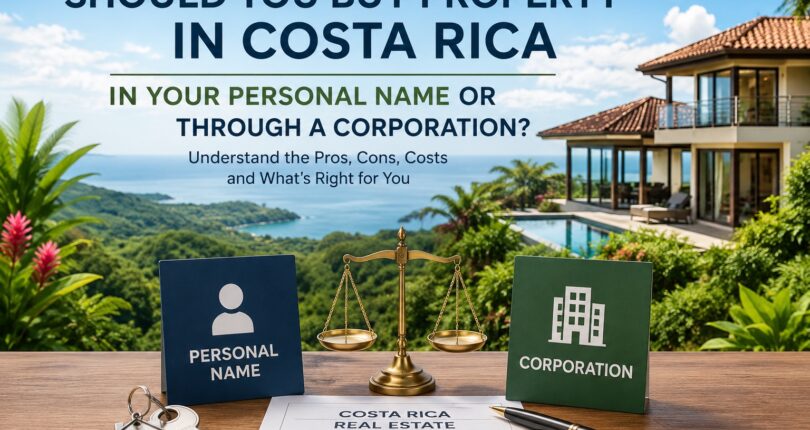
Should You Buy Property in Costa Rica in Your Personal Name or Through a Corporation? A Complete Guide for Foreign Buyers
If you’re from the United States, Canada, or Europe and are planning to buy property in Costa Rica, one of the most important legal decisions you’ll make is how to hold title to your property.
Should you purchase the property in your personal name or through a Costa Rican corporation?
The answer isn’t that one option is universally better than the other. Instead, the right choice depends on your financial goals, estate planning, residency intentions, and long-term investment strategy.
Making the wrong decision can cost thousands—or even tens of thousands—of dollars later if you decide to transfer ownership or restructure your investment. Taking the time to understand the advantages and disadvantages of each ownership method before closing can save significant legal fees and unnecessary taxes in the future.
This guide explains the key differences to help you make an informed decision.
Buying Property in Your Personal Name
For many foreign buyers, purchasing property in their personal name is the simplest and most cost-effective option.
In fact, if you are applying for Costa Rican residency under the Investor Category (Law No. 9996), the qualifying investment generally must be held in your personal name. Costa Rica has tightened its residency requirements, making it more difficult for applicants to qualify when the investment is owned by a corporation rather than the individual.
Benefits of Personal Ownership
Lower annual costs
Owning property personally eliminates many of the ongoing expenses associated with maintaining a corporation.
For example, you generally avoid:
- Annual corporate tax (currently approximately ₡69,330, or about USD $150, subject to government changes)
- Annual shareholder registry compliance
- Annual corporate income tax filings
- Attorney fees for maintaining corporate compliance, which can often exceed USD $350 per year for non-residents
Over many years, these recurring expenses can add up to several thousand dollars.
Less administration
Without a corporation, there are fewer legal filings, fewer reporting requirements, and significantly less paperwork to manage each year.
Simpler ownership
Many buyers who intend to use the property as a vacation home or retirement residence find that personal ownership provides the simplest structure.
What Happens If You Pass Away?
One concern many buyers have is how their heirs will inherit the property.
If the property is held in your personal name, your estate will generally pass through Costa Rica’s probate process unless other legal planning has been completed.
Preparing a valid will before it becomes necessary can significantly reduce legal costs, minimize delays, and make the process much easier for your family during an already difficult time.
Buying Property Through a Costa Rican Corporation
There are circumstances where purchasing through a corporation can be the better long-term strategy.
The benefits often become more valuable for buyers who own multiple properties, operate rental businesses, or have more complex estate planning needs.
Benefits of Corporate Ownership
Asset protection
One of the primary advantages is liability protection.
Generally, when assets are properly owned by a corporation and corporate formalities are maintained, personal creditors may have more difficulty reaching corporate assets than assets owned directly by an individual. The level of protection depends on the specific facts of each case and applicable law, so legal advice is essential.
Estate planning advantages
A corporation can also simplify the transfer of ownership to future generations.
Rather than transferring the real estate itself, ownership of the corporation may be transferred through its shares.
For example, if you transfer 100% of the corporation’s shares to your children or other family members during your lifetime, ownership of the property can remain with the corporation and your family. This will eliminate the need to transfer title to the real estate itself.
If the shares have not been transferred before death, and your heirs inherit them through your estate, probate and legal costs may still apply.
Because every family’s situation is different, it is important to discuss estate planning with a qualified Costa Rican attorney before deciding on an ownership structure.
Which Option Is Right for You?
There is no one-size-fits-all answer.
Owning property in your personal name is often the best choice for buyers who:
- Want the lowest ongoing costs
- Plan to apply for Investor Residency
- Own a vacation or retirement home
- Prefer a simple ownership structure
A corporation may be more appropriate for buyers who:
- Own multiple investment properties
- Operate rental or commercial businesses
- Want additional liability protection
- Have sophisticated estate planning objectives
Your decision should take into account your residency plans, tax considerations, inheritance goals, and long-term investment strategy—not just today’s closing costs.
Final Thoughts
Buying real estate in Costa Rica is an exciting investment, but how you take title is just as important as choosing the right property.
The ownership structure you select today can affect future legal expenses, annual maintenance costs, residency eligibility, asset protection, and how easily your property can be transferred to your heirs.
Before closing, consult with an experienced Costa Rican real estate attorney and your tax advisor in your home country. A small investment in professional advice today can help you avoid costly mistakes tomorrow.
Whether you are purchasing a vacation home, retirement property, rental investment, or luxury estate in the Costa Rica real estate market, choosing the right ownership structure from the beginning will help protect your investment and provide peace of mind for years to come.




Join The Discussion